Showing posts with label gender roles. Show all posts

Tuesday, June 8, 2010

Can You Spot What's Missing?

I was just looking for some statistics on the RAINN website and I noticed that something was missing. They provide a lot of useful information including a breakdown of victims of sexual assault by gender and age, a list of effects of sexual assault on victims and society, the frequency with which assaults happen and with which they are reported and then the provide information about rapists.

Here is what they provide:

Approximately 2/3 of rapes were committed by someone known to the victim.
73% of sexual assaults were perpetrated by a non-stranger.
38% of rapists are a friend or acquaintance.
28% are an intimate.
7% are a relative.

He's not Hiding in the Bushes

More than 50% of all rape/sexual assault incidents were reported by victims to have occured within 1 mile of their home or at their home.

  • 4 in 10 take place at the victim's home.
  • 2 in 10 take place at the home of a friend, neighbor, or relative.
  • 1 in 12 take place in a parking garage.

43% of rapes occur between 6:00pm and midnight.

  • 24% occur between midnight and 6:00am.
  • The other 33% take place between 6:00am and 6:00pm.

The Criminal

  • The average age of a rapist is 31 years old.
  • 52% are white.
  • 22% of imprisoned rapists report that they are married.
  • Juveniles accounted for 16% of forcible rape arrestees in 1995 and 17% of those arrested for other sex offenses.
  • In 1 in 3 sexual assaults, the perpetrator was intoxicated — 30% with alcohol, 4% with drugs.
  • In 2001, 11% of rapes involved the use of a weapon — 3% used a gun, 6% used a knife, and 2 % used another form of weapon.
  • 84% of victims reported the use of physical force only.
Rapists are more likely to be a serial criminal than a serial rapist.

46% of rapists who were released from prison were re-arrested within 3 years of their release for another crime.

  • 18.6% for a violent offense.
  • 14.8% for a property offense.
  • 11.2% for a drug offense.
  • 20.5% for a public-order offense.

They do say "he is not hiding in the bushes" but that is the ONLY reference they make to gender. They were very interested in gender when it came to victims but that information is strikingly absent when it came time to discuss perpetrators. They mention the age of perpetrators, the race and even the marital status but not the gender!

I came to the site looking for information on how how often women commit rape to compare to how often men commit rape. That information cannot be found. If someone else has that information (or can find it elsewhere on this site) please do let me know.

I do not wish to castigate RAINN, I think they do amazing, necessary work. I just wonder why they left that rather important, even crucial, detail out? I believe that they assume that we will assume that the perpetrator is a man. It is such a commonly understood fact that men rape and women are raped that it goes without saying on one of the best resources for victims and researchers alike. So entrenched are we in rape culture that we do not even need to be told that men are the most likely offenders even on a website dedicated to providing statistics about those very crimes. But beyond that, it misses an important opportunity to highlight assaults committed by non-typical offenders like women against women and women against men and in so doing, erases the experiences of those victims.

Thursday, June 3, 2010

All too often, seemingly well intentioned people create anti-sexual assault or anti-harassment ad campaigns that just don't get it. Like this one. And in case you don't get why that campaign is ineffectual and has the potential to cause more harm, read this post.

That being said, I really like this new ad campaign airing in Wales. It is right on because it depicts the damage that repeated harassment causes. One comment, one grope, one stare, one catcall; they all seem like no big deal. But as I have said repeatedly, women live in a state of constant terror because we deal with those seemingly little things constantly throughout our ENTIRE LIVES. And beyond that, they contribute to a culture that does not respect women as full human beings who have a right to not be assaulted.

Tuesday, May 25, 2010

Boy Toys/Girl Toys

About two weeks ago I wrote about the highest and lowest paying college degrees and noted that the degrees with the greatest financial value are in fields dominated by men. Today I found this amusing comic that offers an, albeit oversimplified, explanation. Gender socialization plays such a massive role in the stratification of our society it is hard to imagine why anyone would argue that nature is responsible for these differences. Here is a series of very clear examples of nurture clearly overpowering nature.


Tuesday, May 18, 2010

Apple's iPad Commercials are Sexist


Are Apple's iPad commercials sexist? Yes.
Not really sure why the title had to be posed as a question. And I would strongly disagree that "it may seem kind of a small thing to freak out over." This is just another of hundreds of thousands of ways in which gender stereotypes are reinforced to the point that they seem to be just the natural order of things.

Monday, May 10, 2010

The Continued Ghettoization of Women's Labor

This list of the worst paying college degrees from the Huffington Post is making its way around the web. I enjoyed reading the list of highest paying college degrees a few weeks ago as well.

I suppose nothing is terribly surprising on those lists but it is sad to see that the value of work generally done by women has not changed at all. We can intellectualize about how raising future generations of engineers is just as important as engineering itself but we passively accept that teachers and social workers make significantly less money than almost any other profession (for which they were formally educated). Seriously, look at both of those lists and it will be clear that men's work is more valued than women's work. And it is clear that the Huffington Post realizes that low paying jobs are women's work and high paying jobs are men's work based on the images they chose to accompany the text. In the article about the highest paying degrees only one out of fourteen of the people pictured appeared to be women. In the article about the lowest paying degrees six out of the eleven people pictured appeared to be women. This is no accident.


What I wonder about these articles is whether they will deter the next generation of college students from choosing social service related majors. If we are to discourage young people from going into social service professions, who is going to do that work (will it even matter with all of the social service cuts)? Moreover, who can afford to do that work? Who can afford to take out over $80,000 in student loans (seriously I know this person) to get an MSW only to find the best paying jobs in that field are in the $40,000s and that is if you can find work at all.

I don't have to be an accountant to know that that investment will never pay off.
And that is depressing because I am in that same situation only my major wasn't directly on that list.

Thursday, September 17, 2009

According to Jim His Wife is His Property

Insomnia is a rotten thing but it did grant me the opportunity to watch a ridiculous show that I otherwise would never have seen. According to Jim is an ABC sitcom that has evidently been on the air for over 8 years. As sitcoms go, it seems pretty typical and unremarkable but the episode that I caught from the first season entitled "Blow Up" seemed a little too familiar for comfort. I realized about halfway through the episode that it was an almost exact copy of the storyline from an episode of Roseanne that aired almost ten years earlier. There were a few little changes to the storyline that made a huge difference in the representation of gender roles.

I think that this summary from Wikipedia really explains the feel of the show pretty well:
"Jim and Cheryl are the perfect middle class American couple. Happily married, living in a suburban house with two adorable (but loud) little girls and a baby boy, they really can't complain much about life – except for those couple fights that neither one can ever let go."


"Blow Up" was about the way that Jim and Cheryl chose to celebrate Valentine's Day. Jim got Cheryl a car safety kit (ever the practical thinker) and Cheryl, at the pushing of her sister, decided to get a sexy photo taken. The fight in this episode (I am going to assume there is one in every episode, as I said, this is not a remarkable sitcom) happened when Jim decided to show his friends, coworkers, and the Kinkos employees the intimate picture, thus humiliating his wife. She tried to explain her humiliation and he just didn't understand. The episode ended hilariously with Jim begging Cheryl to take down the giant portrait of herself that was in the shop window where she had the picture taken. Now that she wanted to show off her body on her own terms he get extremely possessive, even getting down on one knee to beg her to take it down. The show ends with Jim presenting Cheryl with a hilarious sexy portrait of his own.
fin

Before I go into an analysis of why this show was sexist and awful, I'd like to share the synopsis for an episode of Roseanne entitled "It Was 20 Years Ago Today" from season 5. In this episode, Roseanne, at the pushing of her sister, decided to take a sexy photo for Dan for their anniversary. He decides to alter her wedding ring to include all of their childrens' birthstones without telling her. Hilarity ensues as she goes on a mad search for her ring and tries to keep the picture a secret. In the photo shoot, she is shy and embarrassed but realizes that Dan loves her and loves looking at her so she gains the confidence to take the pictures. In the end Dan loves the picture and respectfully keeps it between the two of them. The show ends with a montage of images of Dan's own sexy pictures.
fin

I don't think I need to tell you why I was reminded of this episode of Roseanne after watching According to Jim. What I do want to share is the remarkable difference that a few subtle changes can make in a storyline like this one. The According to Jim episode was about betrayal and objectification. Jim decided that since his wife is his property, there is really no harm in sharing her sexualized body with everyone he knows. He really didn't think that there was one thing wrong with that. When Cheryl expressed her betrayal and feelings of violation, it was all set up for laughs. Because it is hilarious when a woman is stripped of her autonomy and is exposed in a provocative way AGAINST HER WILL. She makes Jim promise not to show the image to anyone else and all is well. Until her brother spots the picture of her blown up and hanging in a window display at the photographer's studio. Cheryl's body is presented in these scenes as being the property first of her brother who hangs his coat over the picture for the entire scene and then of her husband who throws a temper tantrum on the street begging Cheryl to take the picture down. In this scene, Cheryl decides that she kind of likes the picture being out and gains a certain confidence from knowing that other women were inspired by her (that could be another post in and of its self). The only indication of Cheryl owning her own body is undermined by Jim's demand that the picture be removed. Cheryl "teaches him a lesson" by telling him that this is exactly how she felt when he was showing the picture off to their friends. Of course, it is not the same thing because the picture is still one of her.

In the Roseanne episode, the sexy photo is an opportunity for Roseanne to explore her sexuality and to be intimate with her husband. The image is not the focus of the episode, the relationships between Dan and Roseanne and Roseanne and her body are the focus of the episode. There is not one second in this episode in which Roseanne is not in control of her own body or her own sexuality and as pathetic as it might be, that is a pretty remarkable thing to see on broadcast television. Dan and Roseanne, like Jim and Cheryl, have three children, have been married for awhile, and their trials and tribulations are the focus of the episodes. Dan and Roseanne had a fight in "It Was 20 Years Ago Today" and the arc of the stories were really almost identical. Yet those subtle differences go a long way to make a show either a piece of misogynist tripe or a story informed by feminist ideals. (It might also be notable that the Roseanne episode was written by a woman while the According to Jim episode was written and directed by two men.)

Tuesday, March 10, 2009

Pee-wee's Playhouse as a Queer Text


I used to watch Pee-wee's Playhouse all the time as a child but I was recently re-introduced to it as an adult and I am totally loving it. Why aren't there more queer, or at least ambiguous, children's television shows available? As a child I never read Pee-wee as anything other than a childlike man in an imaginary world with kooky characters. As an adult I see the queer subtext all over. Whether it be the overdone caricature of femininity that Miss Yvonne performed or the almost maternal male femininity performed by Pee-wee, both provided a critique of hegemonic gender by presenting a parody of it. I know a lot of readers of this blog are children of the 1980s and wonder what you all think?

Also, has anyone heard that Pee-wee's Playhouse is going to be made into a movie to come out in 2011?

Sunday, November 9, 2008

Feminism in Country Music

Sorry for the lack of regular and relevant posts; I have been working hard on my thesis and finishing up my last year of course work.

But today I want to take a break from Kurt Cobain and write about a topic that has only recently caught my attention: women in country music.

My mother loves country music so I heard a lot of it as a youngster. And, like most things my mother liked, I rebelled strongly against it. I have never been a fan of country music in fact I used to put it on my list of most hated music. Recently, in homesick moments, I really enjoy a nice bluesy country tune. Nothing is better for heartache than country music. No, really. I even think that some female country music singers advocate feminism in their lyrics and lifestyles.

I decided to look up the lyrics of a few tunes that I have been thinking about lately. Each one of these songs has a complicated message about gender roles. I am reminded again of Melissa McEwan's blog post, "Feminism 101: How are we Supposed to Take Feminist Bloggers Seriously if they Post About Shoes?" in which she writes:
"Making the personal public and political is serious business. Because women's stories aren't told, it's incumbent upon female feminists to tell their own stories, to fill that void, to be unrepentant and loquacious raconteurs every chance we get, to talk about our bodies, our struggles, our triumphs, our needs, our lives in every aspect. It's our obligation to create a cacophony with our personal narratives, until there is a constant din that translates into equality, into balance."
This is the basis of standpoint feminist epistemology. Women's lives are not written into the dominant culture the way that men's are, especially women whose oppression is intersectional and complex. This makes some women's narratives feminist action. I don't mean to imply that just because a woman is speaking she is a feminist but I have noticed some distinctly feminist standpoints in country music.


Below are lyrics from several noteworthy tunes followed by my analysis. Enjoy.

"Well I was born a coal miner's daughter in a cabin on a hill in Butcher Holler.
We were poor but we had love
That's the one thing that daddy made sure of
He shoveled coal to make a poor man's dollar.

My daddy worked all night in the van lier coal mines
All day long in a field of whole and corn
Mommy rocked the babies at night and read the bible by the coal lore light
And everything would start all over come break of morning
Daddy loved and raised the kids on a miner's pay
Mommy scrubbed our clothes on a washboard everyday
While I seen her fingers bleed to complain there was no need
She'd smile in mommy's understanding way...
Yeah, I'm proud to be a coal miner's daughter."

"Coal Miner's Daughter" Loretta Lynn
A theme I noticed across this genre is the struggle of the working class and the working poor. This is one of the older songs on my list but Loretta Lynn is a classic country feminist. Here she writes about living in poverty. There isn't much political insight and she does identify herself in terms of her relationship to a man (her father). However, she identifies with his struggles and respects both of her parents for doing the best they could with limited resources. Gender is only one site of oppression, class seems to be more visceral here.
"Well you thought I'd be waitin' up when you came home last night
You'd been out with all the boys and you ended up half tight
But liquor and love that just don't mix leave a bottle or me behind
And don't come home a drinkin' with lovin' on your mind
Just stay out there on the town and see what you can find
Cause if you want that kind of love well you don't need none of mine
So don't come home a drinkin' with lovin' on your mind."

"Don't Come Home A-Drinkin'" Loretta Lynn

"All these years I`ve stayed at home while you had all your fun
And every year that`s gone by another baby`s come
There`s gonna be some changes made right here on Nursery Hill
This old maternity dress I`ve got is going in the garbage
The clothes I`m wearing from now on won`t take up so much yardage
Miniskirts hotpants and a few little fancy frills
Yeah I`m making up for all those years since I've got the pill."

"The Pill" Loretta Lynn
In these two songs Lynn takes on issues of gender. In "Don't Come Home A-Drinkin'" Lynn's lyrics conjure images of domestic violence and sexual assault. Still this song does not paint Lynn as a victim, she uses her voice and her music to tell him that she won't stand for the abuse. Then in "The Pill" Lynn sings about, you guessed it, the pill. I don't know about you, but I haven't heard many songs about birth control. Lynn speaks about how access to birth control empowered her to be more sexually adventurous and less restricted by monogamy. Many of Lynn's songs are about difficult topics like poverty and abuse yet she never seems victimized by these positions but rather uses them to empower herself through her art.
"Daddy said, 'Now come girl, we're headin' down the road to Augusta.'
And faintly through his clenched teeth, he called Mama's name, and then he cussed her
He said, 'Girl, you're young, but some dude has come along and stole your mother.
Ah, but you can't steal a willin' mind 'cause mama's always lookin' for a lover.'

With dusty teardrops on his face, my daddy cried an' big steps he was takin'
And halfway runnin' to keep up, my shorter legs were so tired and shakin.'
'Where did I go wrong, girl? Why would she leave us both this way?'
At times like these, a child of ten never knows exactly what to say

We searched in every bar room, and honky-tonk as well
And finally Daddy found them, and Lord, you know, the rest is hard to tell
He sent me out to wait, but scared, I looked back through the door
And Daddy left them both soakin' up the sawdust on the floor."

"Blood Red and Going Down" Tanya Tucker
I included this tune because I love Tanya Tucker. She also frequently writes about domestic violence and in this tune she implies (though never explicitly says) that her father murdered her mother. What is so interesting is that country music is frequently chastized for being backwards and anti-intellectual. Still, according to endabuse.org, "Women are much more likely than men to be killed by an intimate partner. In 2000, intimate partner homicides accounted for 33.5 percent of the murders of women and less than four percent of the murders of men." Domestic abuse seems to cut across class and race differences. There are, of course, differences but the difference between country music and so-called 'high brow' art is that female country artists speak much more freely about the reality of their private lives. I have included here several more country songs that contain narratives of sexual and domestic violence.
"Well she seemed all right by dawn's early light
Though she looked a little worried and weak
She tried to pretend he wasn't drinkin' again
But daddy left the proof on her cheek
and I was only eight years old that summer
And I always seemed to be in the way
So I took myself down to the fair in town
On Independence Day

Well word gets a round in a small, small town
They said he was a dangerous man
Mama was proud and she stood her ground
But she knew she was on the losin' end
Some folks whispered and some folks talked
But everybody looked the other way
And when time ran out there was no one about
On Independence Day...

Well she lit up the sky that fourth of July
By the time that the firemen come
They just put out the flames
and took down some names
And send me to the county home
Now I ain't sayin' it's right or it's wrong
But maybe it's the only way."

"Independence Day" Martina McBride
Several decades after Loretta Lynn and Tanya Tucker sang about domestic abuse, Martina McBride added her own narrative to the country music archive. "Independence Day" is about the day that the narrator's mother leaves her abusive father which happens to be American Independence Day. I especially love that anti-choice, conservative republican, Sarah Palin's, team used this as her campaign song. Martina McBride went along with it and, in turn, donated all of the royalties to Planned Parenthood. While it is clearly a liberal (as opposed to radical) move, McBride seems like a feminist to me. Another of her tunes, "This One's for the Girls," is a great feminist anthem.
"You've got a thing or two to learn about me baby
'Cause I ain't taking it no more and I don't mean maybe
You don't know right from wrong
Well the love we had is gone
So blame it on your lying, cheating, cold deadbeating,
Two-timing, double dealing
Mean mistreating, loving heart."

"Blame on your Heart" Patty Loveless
I like this song because it demonstrates the complexity of country music. While plenty of women sing about violence and abuse at the hands of their fathers and/or lovers they also sing about desire and pleasure. I think it is important to recognize that pleasure and danger co-exist.
"I didn't know my own strength
'Till I had to pick myself up
And carry on without your love
Oh,I'm gettin' back on my feet
It's been a long hard fall
But I'll make it after all."
"I Didn't Know my Own Strength" Lorrie Morgan
This song has gotten me through some tough times. The message of empowerment through self-reliance seems overtly feminist, though not without problem, to me.
"Phone rings baby cries TV diet guru lies
Good morning honey
Go to work make up try to keep the balance up
Between love and money
She used to tie her hair up in ribbons and bows
Sign her letters with X's and O's
Got a picture of her mama in heels and pearls
She's tryin' to make it in her daddy's world
She's an American girl."

"XXX's and OOO's (An American Girl)" Trisha Yearwood

"Well, I ain't never been the Barbie doll type
No, I can't swig that sweet Champagne, I'd rather drink beer all night
In a tavern or in a honky tonk or on a four-wheel drive tailgate
I've got posters on my wall of Skynyrd, Kid and Strait

Some people look down on me, but I don't give a rip
I'll stand barefooted in my own front yard with a baby on my hip
'Cause I'm a redneck woman
I ain't no high class broad
I'm just a product of my raising
I say, 'hey ya'll' and 'yee-haw'
And I keep my Christmas lights on
On my front porch all year long
And I know all the words to every [Tanya Tucker] song
So here's to all my sisters out there keeping it country."

"Redneck Woman" Gretchen Wilson
Another theme, in these more recent tunes, is that of pride. With all of its problems and complications, being a country women seems to be a source of culture, heritage and pride. Of course, that pride has been interpreted as racist, homophobic and, perhaps, ignorant it is still a unique and valid standpoint. These women seem to have in common an experience of femininity and duty, pleasure and danger, pride and survival.

This is by no means a complete list, these are just some songs I like with some themes I noticed. I think that this would make an interesting study. Perhaps a future research project.

All lyrics from Cowboy Lyrics.

Monday, August 4, 2008

Eve and Wall-E


I finally saw Wall-E. I hadn't really planned to see it but so many people I know really liked it and the trailer seemed so adorable... well I just couldn't resist. Before I discuss the movie I'd like to discuss the inaccessibility of feature films. I took a friend to see Wall-E and for the two of us, factoring in my student discount and not purchasing any snacks, it cost over $20! I could have purchased groceries for myself for a week with that. I guess that that is why I don't go to movies very often. I am tired of being criticized for being so out of the loop when I don't know about the recent blockbusters. Seeing movies in the theatre is a privilege that I cannot imagine very many people can afford to indulge in regularly.

Naturally, what I found most interesting about this film was the anthropomorphism and gendering of the robots. How do viewers become aware that Wall-E is supposed to be male? I guess it is never made explicit but I believe it was intended. The name Wally is male. But WALL-E is an acronym for "Waste Allocation Load Lifter- Earth Class." The other major character is Eve or as Walle-E calls her Eva. Eve is obviously a feminine name. I think that viewers are to gather that Wall-E and Eve are a nice heteronormative couple who happen to be genderless, sexless robots.

When Wall-E and Eve are aboard the Axiom we see many other robots some of which are clearly gendered, wearing make-up for example, and many that have no obvious gendered identifiers. I don't want to go into the depiction of humans in this film because many other feminist bloggers did a great job. Please read their interpretations!

Besides the rather odd signifiers of gender in seemingly genderless robots and the heteronormativity implicit in those signifiers, I think that Wall-E also challenges traditional notions of gender. If Wall-E was intended to be male, he behaves in a way that challenges hegemonic masculinity. He is obsessed with the idea of romance and companionship. He watches Hello Dolly and dances. He is very emotional. He takes care of Eve and 'falls in love' with her. He courts her tirelessly despite her seeming indifference to him. At the end he becomes very weak and she saves him! Eve is consistently depicted as the stronger and smarter of the two and at the end, she saves his life. Or as my friend Sophie puts it: Eve is badass. Indeed.

Again we are handed a complicated situation. On the one hand gendering robots so that they might fit into the accepted mold of heteronormative coupling is far from progressive. On the other hand, presenting the 'female' robot as the stronger, sleeker, smarter of the two is pretty progressive for Disney.

I really enjoyed the film, mostly because I thought that Wall-E and Eve were so adorable. I actually cried at the end!

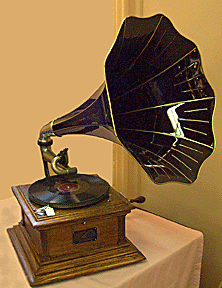
Also, I think that Eve looks like an iPod and Wall-E looks like... a Victrola?

Wednesday, April 30, 2008

I Am Angry About Grand Theft Auto IV


I am angry.

I am angry about a 'game' called Grand Theft Auto IV. I am angry because this 'game' romanticizes, decontextualizes and glorifies male violence against women and against other men. It portrays women as the sex class (willing and available) and men as autonomous agents with full subjectivity (as long as they are hegemonicly masculine). I am angry because this is the result of living in a patriarchal, ethnocentric, xenophobic, homophobic and, yes I'll say it, woman hating culture. I cannot understand this 'game' as anything other than that.

I am scared to live in a culture where this is considered a viable form of entertainment. The protagonist of Grand Theft Auto IV, Niko Bellic, fucks women, seemingly all prostituted women, and then brutally murders them immediately afterward if he so desires. Bear in mind, of course, that 'he' is controlled by the player. Young men all over the country (and beyond) will learn that the value of women is their capacity to provide male orgasm. That is all.

I am angry that abuses of women are not taken seriously; are not seen as major social problems. In this culture of domination the murder of a prostituted/raped woman cannot be taken too seriously. Yet in video game culture it is not seen as a problem. Stamp an "M for Mature" rating on it and move on.

It seems worth examining the otherness of Bellic here as well. Admittedly, I am no expert in gaming or gaming culture, I have only played a few in my life and have never been amused by their seeming androcentrism, exclusivity and extraordinary violence. Bellic is a Bosnian immigrant in search of "The American Dream." I think it is relevant that in a game produced and developed by plenty of white men, Bellic is depicted as 'foreign' and/or not white. It enables white American men to play the game and distance themselves from the extraordinary violence that they are enacting upon women and other men. "Oh American men do not murder, rape or pay for sex!"

In a time when immigration is such a heated issue, Grand Theft Auto IV must be placed within its proper cultural context. It is not an accident that Bellic is a violent, over sexed, thuggish immigrant.

Tuesday, January 15, 2008

Dr. Phil Duo

I need to get another job. This can be evidenced by the fact that I have been watching too much Dr. Phil. What is so fascinating about this is that I watched episodes on Thursday and Friday which were just so strikingly sexist, particularly in relationship to one another, that I almost couldn't believe it.

On Thursday Robin McGraw, Dr. Phil's wife, had the opportunity to tell women what we need to do to look ten years younger during an oh-so-tired makeover show. Apparently all it takes to be a happier menopausal woman is microderm abrasion, teeth whitening, cellulite reduction cream, velashaping (?), eyebrow sculpting, 'natural' hormone therapy, not eating, a gym membership, working out in the proper (name brand) gear, an iPod, sunglasses, perfume, high heels, bubble baths, a cocktail dress, a crap-load of make up and a haircut. (Seriously, all of these things were mentioned!)


Image Via

The show featured five 40-50 year old women who were unhappy with their appearance.
"I've become a frumpy mom... I'm not feeling pretty anymore!"
Dr. Phil's only apparent reason for even being in this episode seemed to be to illustrate the contrast between men and women. Every time Robin named off some inane new beauty treatment he would shake his head in that condescending "oh you silly women" way. He joked many times about how women just like to be pretty and thin, blah, blah, blah. He lectured the women about going to the gym (one of them moaned about weighing 130 lbs!) AND he consistently referred to them as 'girls!' Remember, they were all between 40 and 50!!

Near the end of the show all of the women came out to show their new make overs. The audience applauded vigorously when Robin announced that one of the women was now a size 4. Now all of these viewers have learned that being a size 4 is how women are valued in mass media, this is the only reason that this woman made it onto broadcast television. This revelation sequence was my very favorite part because the first thing Dr. Phil did was ask the women's husbands how they thought that their wives looked. He didn't ask the women how they felt or what they thought. No, he was much more concerned with whether their torturous beauty rituals had succeeded in making their fat, balding husbands' dicks hard. Job well done! And of course, all of this was presented as being some great treat for all of these women.

Another portion of the show was spent at the mall. Robin showed viewers how to shop so that you can look years younger! She did this with her token gay man and her vacuous Barbie-doll-looking daughter-in-law.

Heternormativity, misogyny and class privilege all smashed into one hour long show. Well done!

~

The show on Friday was seemingly very different in its focus. However, if you pay attention to the subtext the connection becomes very clear.

The first part of the show was about Adam who is $200,000 in debt. Adam's family thinks that he is too concerned with material things. He claimed (and no one really disagreed) that "it's all about image." I am assuming he meant life.

Image Via

He would buy himself new vehicles at an alarming rate and he went to the tanning salon and got his hair done before being on the show. These things apparently demonstrate his obsession with his image. Dr. Phil's advice for him?

"Why do you care so much about what people think?
"Why do you need that Hummer to perceive yourself as okay?"
"Don't be that shallow, don't define yourself by that stuff."

Now remember that just one day earlier he and his wife were encouraging women to do those very things!! To absorb themselves in their image, to allow their possessions to define them, to be extremely concerned with their outward appearance. Now when a man is perceived as doing those very same things, he is told that that is unacceptable. He should not be so concerned with material things or with his appearance. No, that is the burden that only women must bear.

Tuesday, January 8, 2008

Romance Vs. Career

I desperately want to be one of these women. Or maybe that's just an effect of a messy break up. I really don't want that. And I don't really buy into the idea that they are dichotomous.

Wednesday, January 2, 2008

Adventures in Wife Swapping

Another perk of being in Green Bay is that ABC's always enlightening "WifeSwap" airs at 12:30 a.m. so in my insomnia I was able to watch it last night. This week's episode featured an "ultra feminist" and a "pageant princess." I valued the opportunity to learn what the mainstream media considers to be feminism and of course I was not disappointed. Angie the "ultra feminist" was also a preacher/stay at home mother (I assume) who homeschooled her three daughters seemed to consider feminism teaching her daughters about women's history, how to take care of a car, and how to stay away from make up, short skirts and those other trappings of femininity. Nothing wrong with any of that of course, but there is NO WAY that is "ultra feminism." If that is ultra feminism what is Catharine MacKinnon?

A few highlights from the show were when the other wife, the pageant mom Karen, told Angie's husband that learning how to wear make up and pleasing men were "Just things she is learning for the future." Of course in our culture she isn't necessarily wrong but rather than challenge that notion at all, she goes to the other extreme and has the most vacuous, self centered, helpless, and frankly stupid child I have ever seen. (Granting of course that this is television and so spectacle is the whole point.)

The word "feminist" was used 15 times in the show (by my rough count) and it was always used as a descriptive word. They never bothered to explain what they meant or why Angie is a feminist, though she does frequently call herself one.

By far my favorite part of the show was the throw down between Angie and Alicia's (pageant princess) father. He seemed to believe that asking his daughter to cook or to be respectful to waitstaff was degrading. Here is what he told Angie:
"I'd like to see your husband... how can he live with you you feminist pig!"
"You are degrading her you feminist pig."
Ouch. And all because she had the audacity to suggest that his daughter is not a piece of meat.

His wife was scarcely better. She tried to get Angie's daughters to 'sparkle' by which she meant put on make up, short skirts and be in pageants. I was pleased to see that Angie's eldest daughter was not easily swayed but it was horribly unfortunate that her middle child fell for it hook line and sinker. AND that by the end Angie and her husband even seemed to approve of it. Remember, she is ABC's version of a feminist. Here are a few things that Alicia's mother told Angie's daughters:
-That being a feminist meant "being ugly and ruling the world."
-That feminism is squashing the 6-year-old's dream
-That feminism is turning them into boys
-And "its not a crime to be pretty"

The most unfortunate thing about this show is that for folks who are not well acquainted with feminism (and being in Green Bay I can say with some confidence, that is most people) this is going to be their introduction. That is frightening. However, I didn't expect much better from ABC.

Sunday, December 30, 2007

Childlessness

Not my nephew.


I do not encounter many children in my day-to-day life in Chicago. I cannot believe how much I have taken that for granted. It is easy to forget why I do not want children of my own when I never see them.

As I may have mentioned, I am in Green Bay with family indefinitely and unfortunately that means lots and lots of time with my 16 month old nephew. Now don't get me wrong, I love him very much and nothing makes me happier these days than seeing his chubby smiling little face. However, OMG he is so annoying!!!

Every morning I am rudely awakened at about seven by his screaming if he is unhappy or his squealing if he is happy. Then constantly for the rest of the day it is one or the other of those two. I have been popping ibuprofen like vitamins. AND if he is not making noise he constantly needs to be watched because he can get into anything. Because he requires their undivided attention, I have not had a decent conversation with my parents since I got here.

I don't want this to just be a laundry list of complaints about the child. Again, I am his aunty and I love him but it was really great to get this reminder of why I am so dedicated to childlessness in my own life. I just do not have the patience or temperament for it. Of course, I might reconsider this decision if I could have a wife....

Sunday, November 25, 2007

The Holidays: A Time for Antiquated Gender Roles


Image Via


The holidays are always a good time to take pause and think about family. I have been thinking a lot about my family because I understand that in order to enact radical change one often has to start with one's self. My family is no feminist haven, in fact, I take the most flak about my beliefs from members of my own family.

A typical Thanksgiving in my family involves my aunt(s), mother, grandmother and myself in the kitchen preparing our feast while my father, brother and uncle sit in the living room watching football. I am told that this is not at all uncommon in other families. As the women served up the dinner that they had spent the entire morning, nay WEEK, preparing for, my uncle and father could not even pry themselves away from the television for long enough to eat with the family. No, instead we all had to watch the game while we ate and tried to converse with on another over the clamor of glorified male violence.

After dinner, the men retired back to the living room to continue the game-watching. At this point I abandoned my post in the kitchen and went out to talk to my uncle. My uncle fancies himself a liberal minded yuppy, but still has a very difficult time understanding my disdain for marriage (he says this to me as he is reclining with a beer watching football being served desert by his wife). He tells me that he has an egalitarian marriage (his wife is the primary caretaker of their twin three year olds despite the fact that she too works full time) and cannot understand why I don't think I could have the same.

Well for starters even women who are determined to step out of their prescribed gender roles seem to fall right back into them after marriage. (At least that appears to be the case of my aunt). The words 'egalitarian' and 'marriage' seem mutually exclusive to me. How can women ever be equal or even safe in an institution that was designed to enslave them? Anyway, my point is that his own enormous level of privilege is completely invisible to my uncle and I find that devastating.

I am saddened by the knowledge that I cannot change even my own family. How on earth do I expect to change the world? If I suggested that the men and women switch roles for a holiday, I am sure I'd be cast right out of my family.

Wednesday, November 14, 2007

"The Gendercator" and Transphobia


Image Via


Tonight I went to a screening of the independent film The Gendercator at the Center on Halsted. This film has been causing quite a stir amongst transpeople across the country and in the queer blogosphere. The film has actually been banned from a few LGBT(qai...) film festivals for supposedly being anti-trans.

I will say that I do not think that this film was anti-trans. I do not think it had anything to do with transgender issues AT ALL. Before I go into an analysis I will give you a brief synopsis. A young non-gender normative lesbian woman falls asleep at a party in the 1970s after smoking much marijuana (or what appeared to be marijuana). She wakes up 75 years later to find that the religious right has taken over. A person can only be a man or a woman and MUST fit into rigid gender categories, brave-new-world-style.

One can have surgery to fit the gender that they prefer but once they are in their new body they MUST comply with the rigid gender roles. This young woman is forced by medical professionals to be surgically transformed into a man. This petrifies her because while she likes women she also likes her androgynous body. In something of a cop-out (on the director's part) the sequence ends up being a dream and she wakes up again to find the 'real' world. Fin.

Anyway, the controversy has arisen because many people see this film as being transphobic. I do not see that. I think the film is a dystopian fantasy in which we see what would happen if the religious right had their way and choice was taken away. This film is very much about force and removal of choice. The surgery in this film was not a result of some deeply felt yearning or life long struggle with one's body image not matching her/his gender identity. This surgery was about a woman being forced to become a man because of her clothing and her sexual object choice. That is something very different indeed.

After screening the film there was a panel discussion with the director, Catharine Crouch, and five other activists/theorists in the gender queer field. The discussion was fascinating. Judith Halberstam was on the panel! She had the most insightful comments, I wish I could have heard more from her. I have long been a fan of her work.

The director defended her film saying that it was meant as a resistance to medicalization of bodies and that straight women are socialized to believe that if they do not look like Barbie they are value-less and that plastic surgery is a way to fit into that norm is scary. She also said that transmen are forced into FTM surgery in order to fit into a gendered norm. Because their bodies are not stereotypically masculine they are not valued as males in our culture. Her argument seemed to be that people should be content with their bodies and not seek surgery as a way of copping out of dealing with non-normative gender.

This is where she got herself into a bit of hot water. NONE of the above things were in her film. These are statements that she has made while on her national tour with this film. The other panelists were rightly upset at the notion that transmen are somehow depoliticized just by virtue of their maleness. Choosing a male body is not a way of avoiding feminism! It is not a way of gaining privilege. It might be a side-effect sometimes, but I seriously doubt that that is the reason many transpeople transition.

One of the things that I enjoyed the most was the reappropriating of the directors notion of medicalization as a tool of the patriarchy. While I agree that it has been used that way (especially in the case of intersexed peoples) it seems to deny transpeople the agency that they deserve. Halberstam argued that medicalization is just a much a tool for trans liberation as it is a tool of the patriarchy.

Image Via

Halberstam was clearly annoyed with Crouch. Crouch seemed to be rather ignorant on trans issues and this is what is getting her into trouble. She is going around the country in the name of starting a dialogue and than openly admitting that she has no idea what trans identity is! She certainly should not be a spokesperson for this community by any means. The film was not anti-trans but the director might well be. As Halberstam suggested, she would do well to read much, much more queer theory before taking on such an ambitious tour.

Finally, I want to say that I think this film is mis-named a satire. There is nothing satirical about it, it is a dystopian fantasy about an extraordinarily conservative regime. Possible? Maybe. Likely? Probably not. All I know after listening to this panel is that Crouch ought not claim to have made a movie about transpeople when it clearly is not. And she probably would do well to pick up some queer theory.

Sunday, November 4, 2007

Parenting and Masculinity on Cable TV

Tonight I had the pleasure of catching an episode of Showbiz Tonight on CNN. I had no idea what to expect of an entertainment news show on cable. The ones I get to see on broadcast TV at home are just wicked and I supposed I shouldn't have expected much more of CNN.

Anyway, one of their feature stories was about the actors in the new film American Gangster which I have not heard much about but I am sure it is another pornographic display of romanticized male violence (perhaps I will write more on that film later). Showbiz Tonight interviewed Denzel Washington and Russell Crowe. Well, mostly it was Denzel lecturing Russell (and anyone else watching) on how to be a father.

Now I should warn readers that I recently finished reading bell hooks' The Will to Change: Men, Masculinity, and Love and it has influenced me. A lot.

Denzel Washington talked about a few key things in child-rearing. He said that "Sports...is the best thing I did." Suggesting that engaging in hyperviolent organized and professional sports is the best thing for children upsets me. Violence is a disease and institutions like professional sports (and I am talking about the football, hockey type sports here) are huge perpetuators of violent behavior.

hooks talks a lot about how men are damaged by patriarchy. She suggests that boys and men are told to turn off their emotions and turn inward at a very young age. Masculinizing institutions like professional sports encourage and reward that type of behavior.

This is only the beginning of Washington's terrifying, patriarchal advice. He also said that he put his son on an inner-city football team and his son hated it. He got a call from the coach saying "Your son is crying." To which Washington said "Be ten times harder on him, if I hear about another tear another whimper I’ll be back down there and put a foot in his behind in front of the team.”

Because when a male child has the audacity to show emotion, to express himself, to dislike absorbing physical violence without a wince, the best thing to do is to kick his ass. I was horrified. That child now knows that men are violent and that he is not a man unless he is violent and if he strays from that hegemonic masculine ideal that he will be harshly punished. I cannot think of worse advice. That is not tough love as Showbiz Tonight so graciously called it, that is abuse.

hooks mission is to teach men and women that their sons need and want love and that when they don't get it they learn a very painful type of masculinity. And it is this blogger's opinion that masculinity is destroying men.

See the video here.

Tuesday, October 30, 2007

On the marriage of racism and sexism at Halloween


Image Via

I have always had a hard time digesting the hypersexualized costumes that so many women don for Halloween. Could all of these women really be sitting around in their everyday clothing just dying to take it all off at first opportunity? What kind of sick male fantasy is that? And why are women so eagerly complicit in this?

These are questions that I have had for a long time but the bloggers over at racialicious brought a whole new level of analysis to this discussion that was very much needed. I strongly encourage you all to read it.

Wednesday, September 12, 2007

The Chronicles of Jan

Image of Melora Hardin via.


NBC's version of "The Office" is undoubtedly one of my favorite television shows. It is hilarious and engaging. That is why it is very difficult for me to be critical of it. But there are a few things about this amazing show that make my stomach turn.

Early in the second season there is an entire episode about sexual harassment. Sexual harassment happens on "The Office" a lot but most of it is very satirical. I can dig satire especially since it is somewhat subversive. The harassment is depicted very ludicrously.

I anxiously awaited the third season finale. This episode revealed who got the job at 'corporate' and Pam and Jim finally appear to be hooking up. Yay!

But early in the episode we discover that the corporate job is available because Jan (Michael's boss in NYC) got fired. The level of glee that people felt over seeing that bitch get knocked down a peg is really quite telling. From the very beginning I was impressed that the person with the most power in this show was a woman. She is the boss of the boss. But she has consistently been depicted as an angry, castrating bitch. Only women who reject any shred of stereotypical femininity can make it in the corporate world. Or at least that is the image that we are inundated with.

Jan gets divorced early in the second season and while on the rebound she has a relationship with Michael. In this relationship Jan is domineering to the point of cruelty. We get the sense that she is totally in control. As this show got more popular, and Jan got more powerful, the writers and producers of "The Office" appeared to be stripping Jan of her power. The last episode is the epitome of this.

Devastated that Michael broke up with her, Jan gets breast implants and begs him to take her back. This is when she loses her job and basically has a total emotional break down.

This reminds me of the episode of "30 Rock" that I watched in which Tina Fey's character (a very powerful television producer) has a total emotional break down and needs to be literally carried off by her co-worker.

I immediately dubbed that an example of backlash but have been much more reluctant to do the same about a show that is so dear to me. The season three finale of "The Office" demonstrates anti-feminist backlash. The powerful women is fired because she is too emotional (which was NEVER demonstrated prior to this episode).

Also notable, when Jim and Karen witnessed Jan's breakdown Karen was delighted because Jan is "crazy" and self-destructive. I am not sure that any of this exemplifies self-destruction as much as the logical conclusion of male domination. Jan was destined to fail from the very beginning because she was a woman in 'a man's world.'

The very best part of all of this (and this completely proves my point that this was intentional misogyny not just good story writing) is that Ryan, the young temp. worker, gets Jan's job at the end of the episode.

Even in a show with egalitarian writers and characters, even in a show that I adore, misogyny is rampant. Still, I eagerly await the season premier. I will most likely address this issue again at that point.

Wednesday, September 5, 2007

Sexism on the CTA (part 1 of 1,000,000,000)

Image via Flickr. Ignore the random dude.

These advertisements are all over Chicago. Specifically, all over the CTA. I am posting it here because I think that it is the perfect marriage (excuse the pun) of patriarchy, heterosexism and capitalism. This ad plays off of insecure masculinity. How do you make wedding rings macho? Why, you equate them with testicles of course.

This ad campaign assumes that all women want engagement rings, that only men can (should?) purchase engagement rings, and that only real men get engaged.

The CTA is FULL of sexist advertisements. The first one I saw was for the movie Captivity. There have been several more since then but I couldn't find them online. I am sure there will be more to come.